Why this question still needs asking
Creative arts interventions are now widely cited in policy documents, clinical guidance and the popular press as a contributor to psychological wellbeing. However, less attention has been paid to how well the existing evidence base translates to two specific contexts: the digital-native lives of Generation Z, and the non-Western settings in which a growing share of mental health need is concentrated.
This essay therefore asks two questions. First, how robust is the empirical evidence that creative-arts interventions improve psychological wellbeing, once the most-cited studies are examined against their own methodological limitations? Second, what does the rise of generative AI and digital-native creative practice imply for the way research in this field should be designed in the next decade?
This article argues that creative arts are a credible adjunct to traditional therapy, but the evidence supporting them rests on a narrow methodological and cultural base. Digital-native and AI-mediated forms of creative practice expose gaps that the next decade of research will need to address.
What the literature actually claims
The broadest case for creative arts in health was put forward by Stuckey and Nobel (2010). Their narrative review in the American Journal of Public Health synthesised work on music, visual art, writing and dance, and concluded that creative engagement reduces stress, alleviates pain and supports identity reconstruction in chronic illness. Malchiodi (2012) provides the clinical complement to this position. In her Handbook of Art Therapy, she defines art therapy as a process-based encounter in which the act of making, rather than the finished object, carries therapeutic value.
The most authoritative recent overview is the scoping review commissioned by the World Health Organization (Fancourt & Finn, 2019), which examined over 900 publications and grouped outcomes into prevention/promotion and management/treatment domains. The report endorsed the arts as a contributor to public health. However, the authors also note that the underlying evidence base is dominated by short-term, small-sample and non-clinical studies. This qualification rarely appears in the popular framing of the field, and it is the starting point for the critique that follows.
Figure 2
Three traits that dominate the WHO-reviewed evidence base
Dominant
Short-term
Most studies report outcomes measured immediately after a session, with little follow-up reporting.
Dominant
Non-clinical sample
Participants are drawn from general adult populations rather than diagnosed groups.
Dominant
Small sample
Sample sizes typically fall below 100, which limits statistical power.
Note. Fancourt and Finn (2019) describe the evidence base as "dominated by short-term, small-sample, non-clinical work". The three cards summarise these qualitative traits; the WHO scoping review does not publish per-trait percentages.
Three empirical anchors, three soft spots
Three empirical studies are routinely cited as the strongest evidence for arts-based intervention. Each has limitations that complicate the conclusions usually drawn from them.
Kaimal et al. (2016) measured salivary cortisol in 39 adults before and after a 45-minute open-studio art-making session, and reported a statistically significant drop in 75% of participants. The finding is widely cited as biological evidence that art-making reduces stress. Two limitations are worth noting. First, the study had no control group, so the effect of art-making cannot be separated from the effect of any 45-minute low-demand activity. Second, the sample was drawn from a non-clinical adult population, which limits inference to the depressed or trauma-affected groups for whom the intervention is usually proposed.
Figure 3
Kaimal et al. (2016): cortisol drop after a single 45-minute session
75%
of 39 participants showed a cortisol drop after a single 45-minute open-studio session
Note. Each circle represents one participant. Filled circles indicate a statistically significant cortisol drop following the session. Adapted from Kaimal et al. (2016).
Bolwerk et al. (2014) used functional MRI to compare older adults assigned to a ten-week art-production course with those in an art-appreciation course. They found greater functional connectivity in the production group in brain regions linked to introspection. This is a stronger design because it has a comparator. However, the total sample (n = 28) is small for neuroimaging work, follow-up was not reported, and the clinical meaning of the finding remains open. Whether the change in connectivity actually translates into measurable wellbeing is not addressed by the study.
Figure 4
Bolwerk et al. (2014): the comparator-design fMRI study
14
Art production group
Made art themselves
After 10 weeks, fMRI showed stronger functional connectivity in brain regions linked to self-monitoring and introspection.
14
Art appreciation group
Looked at and discussed art
Same dose of time, same artworks, but no measurable change in connectivity.
Note. Adapted from Bolwerk et al. (2014).
Zhang et al. (2025) conducted a meta-analysis of music-based interventions for subjective wellbeing, pooling ten randomised trials covering 713 participants and reporting a significant positive association, with the strongest effects observed for music therapy in clinical populations. The review is methodologically careful. However, the authors themselves flag substantial heterogeneity across the included trials (I² = 83.7%), the field's continued reliance on self-report measures susceptible to social desirability bias, and the absence of standardised intervention protocols. Several included studies also lacked long-term follow-up, which leaves open whether the observed effects persist beyond the intervention window.
Figure 5
Zhang et al. (2025): pooled effects of music-based interventions on subjective wellbeing
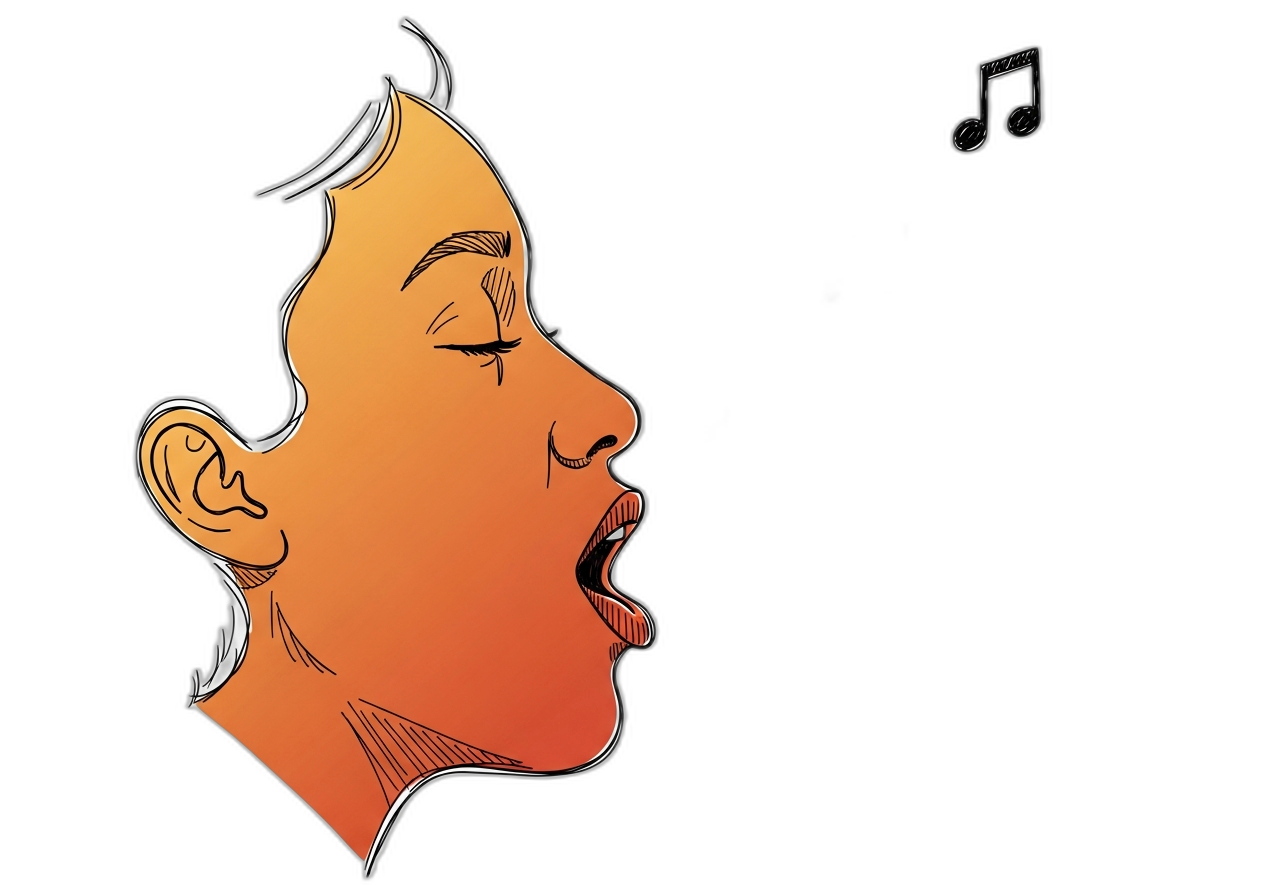
Note. Illustration; data summary based on Zhang et al. (2025) meta-analysis of music-based interventions for subjective wellbeing.
Taken together, the strongest empirical evidence in this field comes from studies that are small, short and largely uncontrolled. This does not mean creative arts have no value, but it does show that the case is weaker than the popular discussion suggests. In addition, almost none of these studies were pre-registered, so it is difficult to distinguish between planned outcomes and outcomes selected after the data were collected. The field also lacks effect-size pooling, which would allow a direct comparison with established therapies. For example, cognitive behavioural therapy for depression is usually reported with Hedges' g of about 0.50 (Cuijpers et al., 2023). The arts-based literature, however, rarely reports effect sizes at all, and when it does, the studies are too different from each other to combine in a meaningful way.
Figure 6
Effect size: what we can and can't measure
Note. CBT effect-size benchmark drawn from established meta-analyses of cognitive behavioural therapy for depression (e.g., Cuijpers et al., 2023). Arts-therapy effect sizes are rarely reported in primary studies, so no comparable benchmark exists.
Whose healing is being measured?
A second limitation concerns who the evidence is about. The three studies above were carried out in the United States, Germany and the United Kingdom respectively, and the Fancourt and Finn (2019) WHO review draws overwhelmingly from European and North American work. For Coventry University students like myself, many of whom come from Chinese, South-East Asian and African backgrounds, this matters in two ways. First, the forms of creative practice that are most familiar in these contexts, such as calligraphy, group dance, religious chant and family-based craft, are under-represented in the cited literature.
Figure 7
Regional concentration of arts-and-health research
Dominant
North America · Western Europe
The bulk of studies in the Fancourt and Finn (2019) WHO scoping review come from these two regions.
Present
East Asia · Latin America
Visible in the literature but in noticeably smaller numbers.
Sparse
South Asia · Middle East · Sub-Saharan Africa
Largely absent from the cited evidence base.
Note. Qualitative grouping based on the author's reading of the geographic distribution of studies in Fancourt and Finn (2019). The WHO scoping review does not publish a region-by-region count, but explicitly observes that the evidence base is dominated by work from North America and the WHO European Region.
Second, the Western therapeutic frame, which emphasises individual self-expression in a private therapeutic dyad, may not align with cultures where art-making is communal, intergenerational or devotional. Chinese calligraphy practice, for example, is often described as a form of stress regulation in older Chinese adults, but its rhythm and social setting do not map neatly onto the studio-based art therapy model that dominates the cited literature. Similar gaps exist for Indian classical music (raga therapy), Indonesian gamelan group practice, and ritual chant traditions across the Islamic world. These practices are widely used in their own communities but rarely appear in the arts-and-health framework adopted by the WHO review. Until the evidence base diversifies along these lines, generalising current findings to a Chinese student audience involves a leap that the studies themselves do not support.
What the existing framework was not designed to answer
The literature reviewed so far was written before generative AI became a routine part of how my generation makes images. This raises a question that the existing framework was not designed to answer. Does AI-assisted creation count therapeutically as the act of making that Malchiodi (2012) places at the centre of arts therapy? On one reading, prompting a model like Midjourney or DALL-E externalises emotion in much the same way that drawing does. The user formulates a feeling, the image arrives, and the result becomes material for reflection. On another reading, the embodied and mistake-rich quality of physical art-making, which Bolwerk et al. (2014) suggested was driving the neural changes they observed, is precisely what AI removes.
Figure 8
Two paths to a finished image
Path A · Making
"Hand on canvas"
~45min
Deliberate · embodied · error-rich
The slow, mistake-rich quality of physical art-making, which Bolwerk et al. (2014) credited with the neural changes they observed.
Path B · Prompting
"A painting of grief"

~12sec
Immediate · disembodied · frictionless
A text-to-image model externalises a feeling in seconds. Does that still count therapeutically as the act of making?
Note. Author's framing of the question raised by extending Malchiodi (2012) and Bolwerk et al. (2014) into the generative-AI context. The 45-minute timing is taken from Kaimal et al. (2016); the 12-second timing is approximate for current diffusion models.
This question is sharpened by the wider concern about screens. Twenge and Campbell (2018) found, in a large U.S. dataset, that adolescents using screens more than four hours daily showed measurably lower psychological wellbeing than lighter users. Their findings do not speak directly to creative AI tools. However, they warn against assuming that any digital activity is benign because it is described as "creative". Whether AI-co-created art belongs with active making or with passive consumption is an open empirical question. The next generation of researchers, including digital media students, will need to design studies to answer it.
Figure 9
Twenge & Campbell (2018): screen time vs. wellbeing
Note. Each dot represents one simulated adolescent. The pattern is drawn to illustrate the four-hour threshold described in Twenge and Campbell (2018); the underlying point dataset is not from the original paper.
It is also worth distinguishing between different kinds of AI tools, because they may have very different therapeutic value. For example, a text-to-image model produces a finished image in seconds with very little user effort, which is closer to passive consumption. On the other hand, a diffusion-based sketch-assist tool allows the user to draw their own lines and uses AI to support the process across several rounds. This second type still keeps the slow and effortful character that the arts-therapy literature considers important. Therefore, putting all these tools under one label such as "AI art" can be misleading, and the same kind of evidential weakness that already affects screen-time research may appear again here.
From a Digital Media student's own experience
Figure 10
The studio screen as both refuge and arena
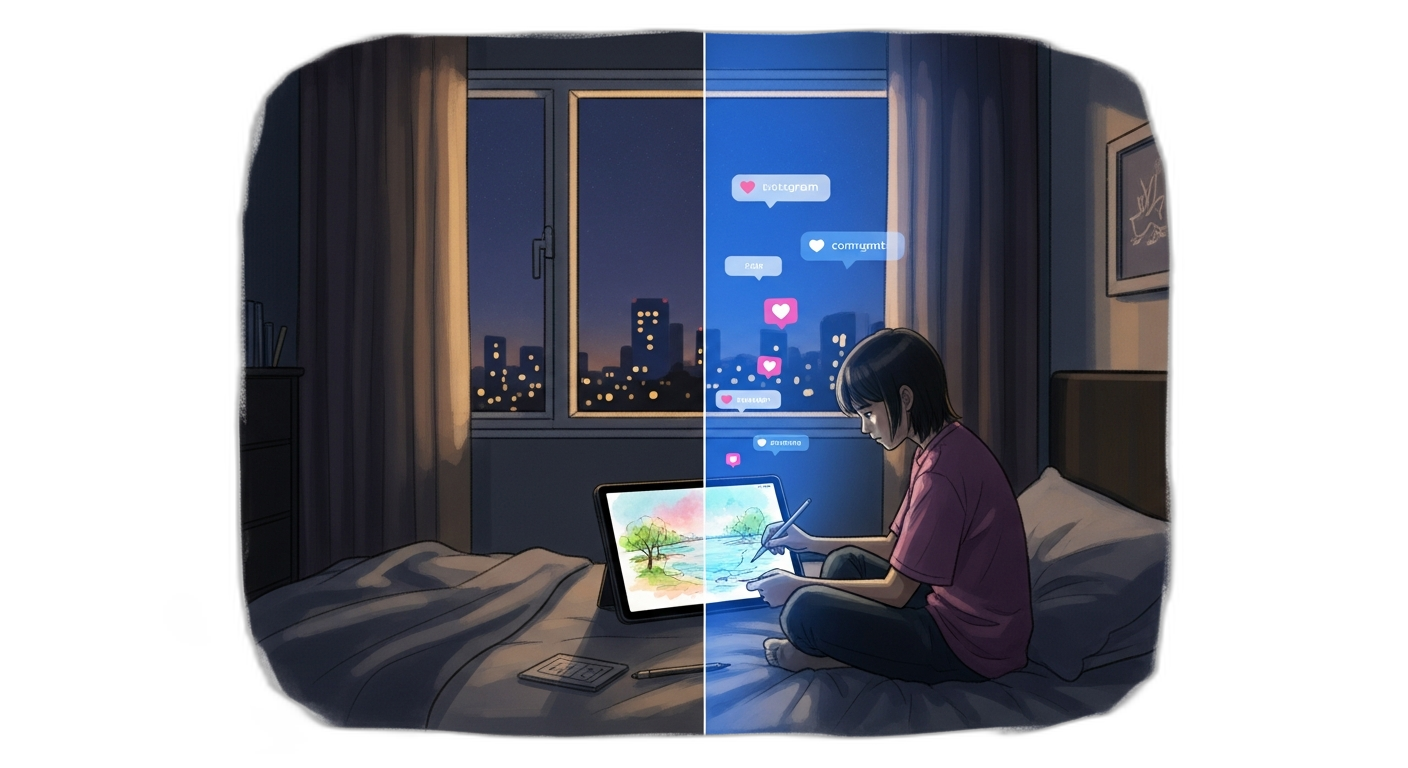
Note. Illustration commissioned for this essay; depicts the dual experience described in this section.
During the lockdown period, I was an international student living alone in Singapore, in an apartment near Marina Bay Sands, and I spent about two months drawing on Procreate. Some of those sessions were genuinely calming in the way the cortisol literature suggests. Others were not, because I was checking at the same time how my drawings performed against other artists' work on Instagram. This dual experience, the studio screen as both a private refuge and a public arena, is something the studies in this essay do not capture.
The cortisol-style research treats art-making as a contained 45-minute event, with the participant returning to a normal day afterwards. For someone drawing on an iPad in 2026, that frame is incomplete. The act of making is entangled with notifications, with audience metrics, and with the latent comparison to AI-generated work that is technically more polished but emotionally less owned. As a Digital Media student, the question I want my own future research and design work to take seriously is not whether digital tools are good or bad for mental health, but under what conditions they tip from one to the other.
An honest inheritance
Overall, the creative arts can be considered as a useful additional method to support traditional therapy, although the evidence base is not perfect. The most cited empirical studies are smaller and less controlled than the popular discussion suggests; the literature is also culturally narrow; and the rise of generative AI brings new questions that the original studies cannot answer. For practitioners and policy makers, a more realistic suggestion is to combine creative arts with established treatments such as CBT and pharmacotherapy, instead of treating them as a replacement. For digital media research and design, the next ten years will need new studies and tools that can address both AI-assisted creative practice and non-Western forms of art-making. Treating healing through expression as both a clinical question and a design question is therefore a reasonable next step, and an area where Digital Media students can make a useful contribution.